Google team
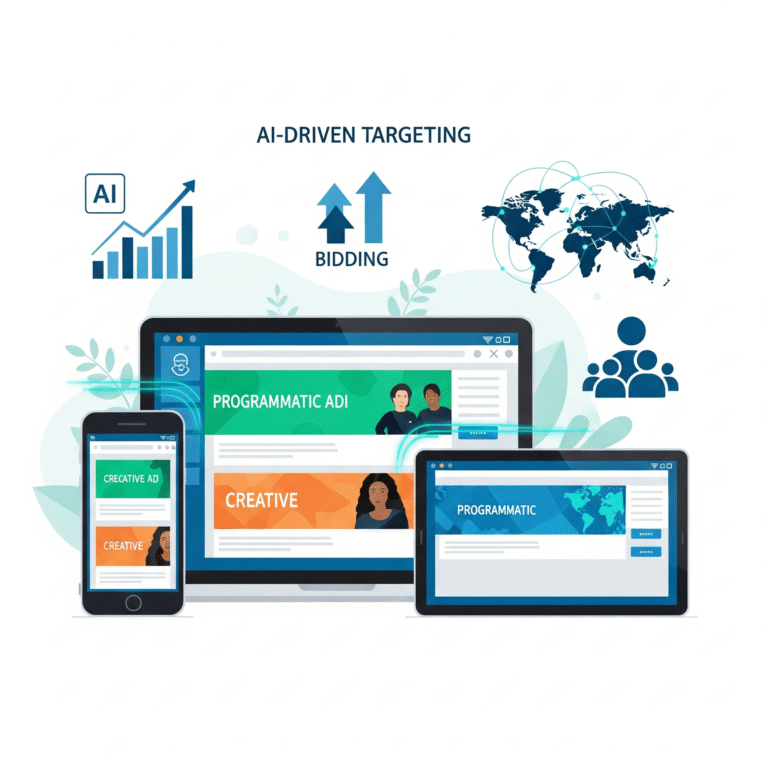
Engage your audience with smart programmatic and display advertising powered by AI.
Programmatic & Display Advertising: Definition, Benefits & Future Trends
What is Programmatic & Display Advertising?
The digital marketing world is evolving quickly, and one of the most powerful innovations today is programmatic advertising. This is an automated process that uses AI, machine learning, and data to deliver ads to the right audience at the right time.
On the other hand, display advertising refers to visual ads such as banners, images, and videos shown on websites, apps, and social media platforms.
👉 In simple terms:
-
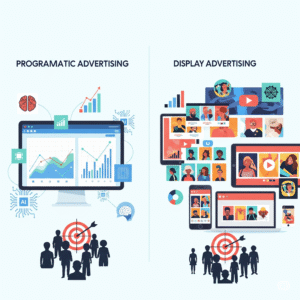
Programmatic = How ads are bought (automation, AI, real-time bidding)
-
Display = Where ads are shown (banners, images, videos, graphics)
Programmatic Advertising Definition
Programmatic advertising is the automated buying and selling of online ad inventory using AI, data, and real-time bidding (RTB).
Instead of relying on manual negotiations between advertisers and publishers, programmatic systems use advanced algorithms to decide:
-
Which ad should be shown
-
To whom it should be shown
-
At what cost and at what time
This makes programmatic ads smarter, faster, and more efficient compared to traditional digital ads.
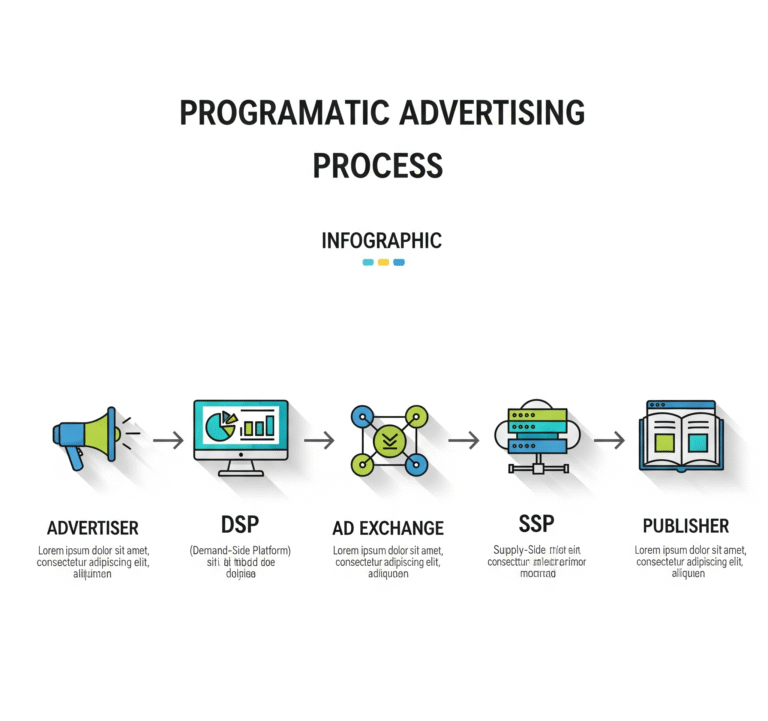
How Does Programmatic Advertising Work?
-
Advertiser Sets Goals – The advertiser defines the budget, audience, and campaign objectives.
-
Real-Time Bidding (RTB) – AI and algorithms participate in an online auction to purchase ad space in milliseconds.
-
Ad Display – The winning ad is instantly displayed on websites, apps, or social platforms.
-
Tracking & Optimization – Performance is monitored in real-time, and campaigns are optimized continuously for better ROI.
Benefits of Programmatic Advertising
-
Precision Targeting – Ads reach the right audience based on demographics, interests, and online behavior.
-
Cost Efficiency – Reduces wasted spend and increases ROI by targeting only relevant users.
-
Real-Time Optimization – Campaigns are adjusted automatically to perform better.
-
Wide Reach – Covers display ads, video ads, mobile ads, OTT, and even connected TV advertising.
Programmatic Advertising vs Display Advertising
| Feature | Programmatic Advertising | Display Advertising |
|---|---|---|
| Buying Process | Automated via AI & RTB | Manual or semi-automated |
| Targeting | Hyper-precise, data-driven | Broad targeting |
| Cost Efficiency | Higher ROI | Moderate ROI |
| Example | Personalized banner on a news site | Static banner on a homepage |
Types of Programmatic Advertising
-
Real-Time Bidding (RTB): Open marketplace auctions where advertisers bid for ad space.
-
Private Marketplaces (PMPs): Invitation-only auctions offering premium ad placements.
-
Programmatic Direct: Direct deals between advertisers and publishers without bidding.
-
Programmatic Guaranteed: Pre-agreed deals with guaranteed impressions and pricing.
Examples of Programmatic Buying Platforms
Some of the most popular programmatic advertising platforms (DSPs) are:
-
Google Display & Video 360
-
Amazon DSP
-
The Trade Desk
-
MediaMath
Future of Programmatic Advertising
-
AI & Machine Learning – Smarter targeting and predictive ad placements.
-
Programmatic TV & OTT – Huge growth in connected TV and streaming ads.
-
Cookieless Future – Rise of contextual targeting due to privacy regulations.
-
Voice & DOOH (Digital Out-of-Home) Ads – Expansion of voice-driven ads and digital billboards.
Frequently Asked Questions (FAQs)
-
What is the meaning of programmatic ads?
Programmatic ads are automated digital advertisements placed using AI and real-time bidding. -
What is the difference between programmatic and display advertising?
Programmatic refers to how ads are bought (automation, AI), while display refers to the ad format (banners, images, videos). -
Is programmatic advertising effective?
Yes, because it delivers higher ROI, precise targeting, and better audience reach compared to traditional methods.
Conclusion
Programmatic and display advertising are revolutionizing digital marketing. By combining automation, AI, and data, advertisers can create smarter, cost-effective, and high-performing campaigns.
The future of digital marketing lies in programmatic TV, OTT advertising, AI-powered personalization, and data-driven display ads. Brands that adopt programmatic marketing today will stay ahead in the competitive digital landscape.
 Nafeesa parveen